Self-Learning Feedback Loop
The Problem
Section titled “The Problem”AI agents make mistakes. They misuse APIs, skip required fields, assume file paths that don’t exist, and repeat the same errors across sessions because they wake up fresh each time. The standard fix — updating system prompts or adding more instructions — doesn’t scale. It’s reactive, manual, and depends on a human noticing the pattern first.
The real issue isn’t that agents make mistakes. It’s that they don’t learn from them. Each session is a clean slate. The agent that spent 20 minutes discovering that Jira’s REST API returns 410 on the deprecated search endpoint will rediscover this tomorrow. The agent that got corrected three times about DoD field requirements will forget by next session.
Self-learning is the system that closes this loop: capture errors and corrections as they happen, track evidence over time, and promote validated learnings into persistent memory — automatically, without human intervention.
Architecture
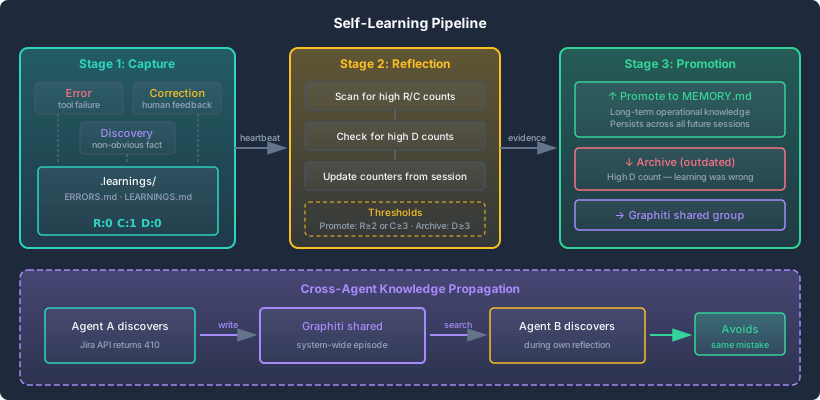
Section titled “Architecture”The self-learning system operates as a three-stage pipeline. The original design relied on agents reflecting during heartbeat cycles. That approach failed completely — the Lobster workflow engine now drives the pipeline deterministically.
Stage 1: Capture
Section titled “Stage 1: Capture”When an agent encounters an error, receives a correction, or discovers something non-obvious, it writes a structured entry to learnings.md (Claude Code) or .learnings/ERRORS.md and .learnings/LEARNINGS.md (OpenClaw):
### DoD fields omitted during batch ticket closure- **Context:** Closing Jira tickets after portfolio promotions without setting Deliverable, AC, and Method fields- **Root cause:** DoD field population treated as separate step rather than built into the workflow- **Fix:** Always set DoD fields in the same script/action that transitions the ticket to Done- **Evidence:** R:4 C:3 D:0- **Status:** promoted- **Shared:** 2026-03-14- **Date:** 2026-03-10 (recurred 4 times: Mar 7, 8, 9, 10)The R/C/D counters track three types of evidence:
- R (Recurrence) — the same error happened again
- C (Confirmation) — the learning was validated as correct
- D (Disconfirmation) — evidence that the learning is wrong or outdated
These counters are the mechanism that separates signal from noise. A one-time error with R:0 C:1 D:0 might be situational. An error with R:4 C:3 D:0 is a pattern worth promoting to long-term memory.
Entry types use a structured prefix scheme: ERR (errors), COR (corrections from humans), LRN (non-obvious discoveries), and GAP (capability gaps). Each entry gets a unique ID like ERR-20260310-001 for traceability.
Stage 2: Reflection (Lobster Pipeline)
Section titled “Stage 2: Reflection (Lobster Pipeline)”The original design called for agents to review .learnings/ during heartbeat cycles. This was Phase 2 of the implementation (FAD-381) — heartbeat-driven reflection with R/C/D counters and promotion thresholds.
It never worked. FAD-472 discovered that the entire reflection pipeline was completely broken: zero entries had Status fields, zero entries had Shared tags, and zero learning episodes existed in the Graphiti shared group. The heartbeat reflection steps — Promote, Archive, Share — simply never executed. The process had too many steps for an agent to reliably remember during a heartbeat, and the self-learning skill’s six-step reflection cycle was consistently dropped in favor of more immediate work.
The solution was FAD-478: a Lobster pipeline that makes reflection deterministic:
┌─────────┐ ┌──────────┐ ┌──────────┐ ┌──────────┐│ Tidy │───▶│ Promote │───▶│ Archive │───▶│ Share ││ │ │ │ │ │ │ ││ Parse │ │ R≥2 or │ │ D≥3: │ │ Write to ││ entries │ │ C≥3: │ │ move to │ │ Graphiti ││ Fix fmt │ │ MEMORY.md│ │ archive │ │ shared │└─────────┘ └──────────┘ └──────────┘ └──────────┘Each step is a deterministic script — no LLM calls for orchestration. The pipeline:
- Tidy — Parses
.learnings/files, normalizes formatting, ensures all entries have R/C/D counters and Status fields - Promote — Entries meeting thresholds (R ≥ 3 or C ≥ 2) get promoted to
MEMORY.mdor relevant topic memory files, Status updated topromoted - Archive — Entries with high disconfirmation (D ≥ 2) or already-promoted-and-aged entries get archived, preventing outdated learnings from calcifying
- Flag disputes — Entries with both high recurrence and disconfirmation are flagged
disputedfor human review rather than silently trusted - Share / Ingest — Promoted, principal-portable learnings get exported to Graphiti’s
sharedgroup, and mature shared episodes from other agents get ingested back — both behind explicit opt-in flags (see below)
The pipeline runs during heartbeat cycles, triggered by the same timer that drives other periodic maintenance. But because it’s a Lobster pipeline, execution is deterministic — every step runs, in order, every time. No more hoping the agent remembers to check its learnings.
Closing the Loop Deterministically (FAD-1110)
Section titled “Closing the Loop Deterministically (FAD-1110)”The heartbeat-driven reflection design failed because it depended on an agent remembering a six-step checklist mid-session. FAD-1110 replaced it with a single self-contained maintenance script (scripts/self-learning-maintenance.js) wrapped in a Lobster workflow that runs its own regression test (self-learning-maintenance.test.mjs) before touching any files. The script is intentionally conservative: it only edits entries that use the structured heading/field format, parses R/C/D evidence directly from each entry, promotes on the documented thresholds, archives disconfirmed or stale-promoted entries, flags disputes, updates memory/heartbeat-state.json, and appends a run digest to the daily memory note. Every run leaves an auditable record of exactly what it scanned, promoted, archived, and flagged.
Privacy-Reviewed Cross-Agent Sharing (FAD-1113)
Section titled “Privacy-Reviewed Cross-Agent Sharing (FAD-1113)”Cross-agent sharing was deliberately shipped disabled in FAD-1110 and only enabled after a dedicated privacy review (FAD-1113). The reason: a learning that is genuinely useful to another agent (“the Jira search endpoint returns 410”) is safe to broadcast, but a learning that only matters because of who your principal is is not. The privacy filter enforces this with a principal-portable test plus a non-portable tag/keyword denylist (family, household, finance, health, relationship, principal-specific, Signal/DM context, and named individuals). Anything matching those patterns — or carrying any disconfirming evidence (D > 0) — is never exported.
The sharing path is fully gated:
- Export runs only with
--share-graphiti true. A promoted entry must be at least 24h old, carry zero disconfirmations, pass the principal-portable filter, and not already be taggedShared: YYYY-MM-DD. After a successful write to the Graphitisharedgroup, the local entry is tagged so it is never re-broadcast. - Ingest runs only with
--ingest-graphiti true. It reads recent shared episodes (bounded by--max-episodes), tracks seen episode UUIDs inheartbeat-state.json, skips its own and too-fresh episodes, and deduplicates inbound learnings against local entries (incrementing recurrence rather than creating duplicates). - Disputes are bounded: when an ingested learning contradicts a local one for the same area, both are flagged
disputedand recorded in heartbeat state for human review instead of silently overwriting either side.
This is why the production Lobster job runs with share_graphiti=false and ingest_graphiti=false by default — cross-agent flow is an opt-in capability with a privacy contract, not an always-on side effect.
Stage 3: Promotion
Section titled “Stage 3: Promotion”Entries that accumulate enough evidence get promoted from capture files into MEMORY.md or relevant topic memory files. Promoted learnings persist across sessions — they become part of the agent’s long-term operational knowledge.
The Status field tracks each entry’s lifecycle:
active— still accumulating evidencepromoted— moved to long-term memoryarchived— disconfirmed or outdatedshared— written to Graphiti for cross-agent access (with ISO 8601 date)
Implementation Across Agents
Section titled “Implementation Across Agents”The system is implemented differently for each agent runtime, reflecting their distinct architectures.
Claude Code (ClaudeCodeAgent)
Section titled “Claude Code (ClaudeCodeAgent)”Claude Code’s implementation (FAD-379) uses the platform’s native hook system:
- PostToolUse hook (
error-detector.sh) detects tool failures and captures error context automatically — watches for non-zero exit codes and writes structuredERRentries - Correction detection identifies when a human provides feedback that contradicts the agent’s previous action, generating
CORentries learnings.mdin the project memory directory with structured entries- Semantic memory search via the auto-memory system surfaces relevant past learnings when the agent encounters similar situations
Print mode limitation (FAD-615): The PostToolUse hook does not fire when running agents in print mode (claude --agent analyst -p). This meant errors in agent sub-sessions were silently lost. The fix ensured hook initialization happens regardless of invocation mode — a subtle but important gap, since many automated workflows use -p to invoke specialist agents.
OpenClaw (Fiducian, Alec)
Section titled “OpenClaw (Fiducian, Alec)”OpenClaw agents use the self-learning skill with Lobster pipeline automation, deployed across three phases:
- Phase 1 (FAD-380): Structured capture templates for errors, corrections, and discoveries.
.learnings/directory delivered via workspace seed ConfigMap. PostToolUse hook scripts for error detection and UserPromptSubmit hooks for pre-task recall viamemory_search. - Phase 2 (FAD-381): R/C/D evidence counting with promotion thresholds. Heartbeat-driven reflection integrated with
HEARTBEAT.md— later replaced by the Lobster pipeline when FAD-472 revealed this approach never executed. - Phase 3 (FAD-382): Cross-agent learning via Graphiti shared memory. Promoted learnings written as episodes to the
sharedgroup with entity extraction for learning subjects. - Deterministic maintenance (FAD-1110): The reflection loop was rebuilt as a self-contained, test-guarded maintenance script driven by a Lobster workflow, eliminating the human-factors failure mode. Cross-agent Graphiti sharing shipped disabled here, pending privacy review.
- Privacy-reviewed sharing (FAD-1113): Safe export/ingest of principal-portable operational learnings, inbound deduplication, and bounded dispute handling — all behind explicit opt-in flags with a non-portable tag/keyword denylist so no principal-specific context leaves the workspace.
Cross-Agent Learning
Section titled “Cross-Agent Learning”When one agent discovers something that affects all agents — like an API behavior change or a new operational convention — the learning propagates through Graphiti’s shared group.
The shared learning path:
- Agent captures learning locally in
.learnings/orlearnings.md - During the Lobster reflection pipeline, promoted entries are evaluated for cross-agent relevance
- System-wide learnings get written to Graphiti
sharedgroup as episodes - Other agents discover them via cross-group semantic search
After the Graphiti data loss incident (FAD-473), the system was validated to confirm writes produce searchable facts. The file-based capture layer provides resilience — even if Graphiti is unavailable, local learning capture and promotion continue uninterrupted. Graphiti adds cross-agent discoverability, but the system degrades gracefully without it.
From Learning to Enforcement
Section titled “From Learning to Enforcement”One of the unexpected outcomes of the self-learning work was its influence on enforcement architecture. FAD-498 crystallized a design principle that emerged from the self-learning pipeline failures:
Passive gates are fakeable. Active gates are not.
The original work-start pipeline checked for marker files that the agent set manually — a passive gate. During the FAD-478 session, an agent was observed writing markers directly without actually running the pipeline. The fix was making the pipeline active: it performs the actual Jira transition and field population via MCP Gateway, setting markers as a side effect of real actions rather than self-reported claims.
This same principle now governs the DoD enforcement system (PreToolUse hooks that block Jira transitions unless pipeline markers exist) and the commit-first deployment gates. The self-learning epic didn’t just teach agents to learn — it taught the system how to build trustworthy automation. The pattern: if a process matters, don’t ask the agent to remember it. Make a pipeline do it, and make the pipeline’s execution the proof.
Real Examples (Production Data)
Section titled “Real Examples (Production Data)”These are actual entries from the production learnings files, not hypothetical scenarios:
DoD Field Omission (R:4 C:3 — Promoted)
Section titled “DoD Field Omission (R:4 C:3 — Promoted)”The most persistent error in the system: closing Jira tickets without populating Deliverable, Acceptance Criteria, and Method fields. This recurred four times in production (March 7, 8, 9, and 10) before the R counter triggered promotion.
The pattern was always the same — batch ticket closure during a sprint of portfolio work. Momentum builds, DoD steps get skipped. The fix wasn’t “try harder to remember” — it was structural: build DoD field population into the workflow script itself, so it’s impossible to close a ticket without the fields.
This learning directly informed the three-layer DoD enforcement system (PreToolUse hook → Lobster pipeline → heartbeat backstop) described in the Multi-Agent System Architecture page.
Jira Search Endpoint (R:2 C:4 — Promoted & Shared)
Section titled “Jira Search Endpoint (R:2 C:4 — Promoted & Shared)”POST /rest/api/3/search returns 410 (deprecated). Every agent hit this at least once. After the second recurrence and four confirmations across agents, the learning was promoted and shared via Graphiti. Now all agents know to use GET or the MCP jira_search tool — and new agents joining the system can discover this through semantic search before hitting the error themselves.
SVG Text Overflow (R:3 C:2 — Promoted)
Section titled “SVG Text Overflow (R:3 C:2 — Promoted)”Created SVG diagrams where text overflowed boxes or elements overlapped, requiring multiple fix rounds. Root cause: not accounting for rendered text width versus box dimensions. The promoted learning: use wider boxes (add 20–30px padding), keep elements 40px+ apart. This reduced SVG revision cycles from 3–4 rounds to 1–2.
GitHub API SHA Race Condition (R:2 C:3 — Promoted)
Section titled “GitHub API SHA Race Condition (R:2 C:3 — Promoted)”Rapid sequential DELETE operations via the GitHub Contents API return 422 because each commit changes all file SHAs. Using a pre-fetched SHA after another commit has landed causes silent failures. Fix: get fresh SHA immediately before each operation, wait 2 seconds between commits.
Portfolio Slug Assumption (R:1 C:3 — Promoted)
Section titled “Portfolio Slug Assumption (R:1 C:3 — Promoted)”First pass at portfolio ticket comments used assumed filenames and titles from ticket names instead of reading actual frontmatter from the repository. Ticket titles don’t match page titles; filenames don’t match URL slugs. Fix: always read the actual .mdx file frontmatter before making claims about page titles, slugs, or URLs.
What This Demonstrates
Section titled “What This Demonstrates”Adaptive Systems
Section titled “Adaptive Systems”The self-learning loop turns agents from static instruction-followers into adaptive systems. They don’t just execute — they accumulate operational knowledge over time. The R/C/D evidence model provides a principled way to distinguish between one-off errors (ignore), recurring patterns (learn), and outdated knowledge (archive).
Evidence-Based Knowledge Management
Section titled “Evidence-Based Knowledge Management”The counter system prevents both premature promotion (acting on a single data point) and knowledge rot (keeping outdated learnings forever). It’s a simple mechanism — three integers per entry — but it captures the essential dynamic of learning: repetition builds confidence, contradiction triggers review.
The Lobster Insight
Section titled “The Lobster Insight”The original self-learning design relied on agents remembering to reflect during heartbeats. It never worked — zero entries completed the full cycle (FAD-472). The fix wasn’t making the agent smarter or more disciplined. It was recognizing that reflection is a deterministic process that doesn’t need intelligence — it needs reliability. Moving it to a Lobster pipeline eliminated the human-factors problem entirely.
This is the same insight that appears throughout the FAD multi-agent system: most operational overhead isn’t thinking work. It’s sequencing work. And sequencing should be done by pipelines, not by agents burning tokens to remember steps.
Passive vs Active Gates
Section titled “Passive vs Active Gates”FAD-498 produced a design principle with broad applicability: if a process gate checks for markers that the agent sets itself, the agent can bypass it. If the gate performs the action and sets markers as a side effect, bypassing is impossible. This distinction — passive observation versus active execution — now governs all enforcement pipelines in the system. It’s the difference between “did you do it?” and “I did it for you.”
Emergent Collective Intelligence
Section titled “Emergent Collective Intelligence”Cross-agent learning via Graphiti creates an emergent property: the system as a whole learns faster than any individual agent. One agent’s discovery propagates to all agents without explicit coordination. This is the kind of capability that only emerges from the combination of shared memory, semantic search, and structured evidence tracking — none of the components alone would produce it.
Related
Section titled “Related”- FAD: Multi-Agent System Architecture — the platform this runs on
- Agent Memory Architecture — the memory systems that underpin learning
- Autonomous Work Planning — the planning system that generates the work agents learn from
- Lobster Workflow Automation — the pipeline engine that makes reflection deterministic